Architecture & Design
System-level overview of NERRF
NERRF System Architecture
High-Level Data Flow
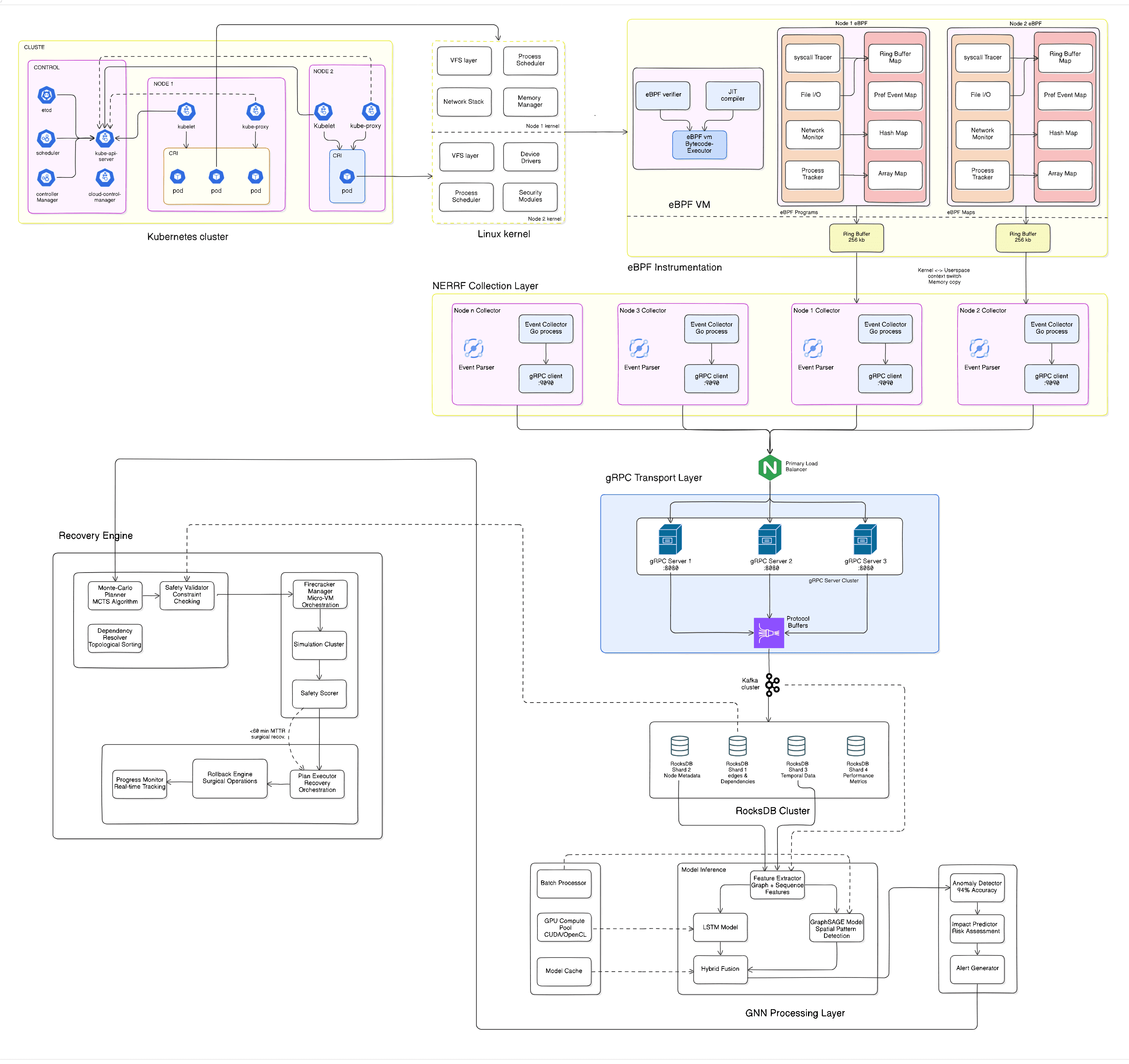
Component Responsibilities
1. Tracker
Purpose: Streaming syscall capture
Responsibilities:
- Attach eBPF tracepoints to kernel syscalls
- Stream events via gRPC to downstream components
- Maintain <5% CPU overhead
- Support 1k+ events/sec throughput
Key Metrics:
- MTTR (Mean Time to Recovery): < 60 min
- False-positive undo rate: < 5%
- Data loss: < 128 MB
Deployment: Kubernetes DaemonSet (one per node)
2. Graph Constructor
Purpose: Build temporal dependency graph
Input: Event stream from Tracker Output: Time-windowed graph (Nodes: processes, files; Edges: dependencies)
Algorithms:
- Sliding window (30-60 sec)
- Node merging (inode deduplication)
- Edge weight = causality confidence
3. AI Models
Purpose: Detect attack patterns + predict impact
GNN (Graph Neural Network)
- Input: Dependency graph
- Task: Anomaly detection (classify edges as normal/attack)
- Model: GraphSAGE-T (28 layers, 2M params)
- Target ROC-AUC: ≥ 0.90
LSTM (Long Short-Term Memory)
- Input: Event sequences (last 100 events per file)
- Task: Encrypt/ransomware pattern prediction
- Model: Bidirectional LSTM (256 hidden, 2 layers)
- Target F1: ≥ 0.95
4. MCTS Planner
Purpose: Generate ranked undo candidates
Input: Graph + anomaly scores + predictions Output: Undo plan (file reversions, process kills)
Algorithm:
- Monte Carlo Tree Search (500-1000 simulations)
- Reward function: restoration gain - side effects
- Timeout: 5 min max planning
5. Undo Sandbox
Purpose: Deterministic replay & safety validation
Technology: Firecracker microVMs
Workflow:
- Clone victim pod root filesystem
- Apply undo operations (reverse writes, file deletion)
- Run deterministic replay (same syscalls, same data)
- Validate: md5sum matches pre-attack version
- Approve if all checks pass
Threat Model: LockBit-Style Ransomware
Attack Phases
Time:    T+0     T+10s   T+30s   T+60s    T+120s
         ├────────┼────────┼────────┼────────┤
Phase:   │ Recon  │ Spread │Encrypt │ Ransom │
         │        │        │        │  Note  │
         └────────┴────────┴────────┴────────┘

Events:
- T+0-10s: Process enumeration (openat /proc/*)
- T+10-30s: Lateral movement (TCP connections)
- T+30-80s: File encryption loop:
    * openat("/app/file_N.dat", O_RDONLY)
    * write("/tmp/buffer", encrypted_data)
    * rename("/app/file_N.dat", "/app/file_N.lockbit3")
    * repeat 1000+ times
- T+80-120s: Ransom note (write "README_LOCKBIT.txt")
Detection Indicators
| Phase | Indicator | Confidence |
|---|---|---|
| Recon | Burst of /proc reads | Medium |
| Spread | Unexpected TCP connections (SMB 445) | High |
| Encrypt | High write-to-rename ratio (>0.8) | Very High |
| Extension pattern (.lockbit, .locked) | Very High | |
| File size shrinkage (partial encrypt) | High | |
| Ransom | Predictable filename (README_*) | Medium |
Data Schema
Event Record
{
    "timestamp": "2025-01-15T10:30:45.123456789Z",  // Wall-clock time
    "pid": 1234,                                      // Process ID
    "tid": 1235,                                      // Thread ID
    "comm": "python3",                                // Executable name
    "syscall": "rename",                              // openat|write|rename
    "path": "/app/uploads/data.dat",                  // Source
    "new_path": "/app/uploads/data.dat.lockbit3",     // Destination (rename)
    "ret_val": 0,                                     // Return value
    "bytes": 1048576,                                 // Bytes written (write only)
    "flags": "O_WRONLY|O_CREAT"                       // File flags (openat only)
}
Temporal Graph Node
{
    "id": "inode:2097152:ts_5000",                    // Unique ID
    "type": "file",                                   // file|process|socket
    "inode": 2097152,                                 // VFS inode
    "path": "/app/uploads/data.dat",                  // File path
    "first_seen": "2025-01-15T10:30:44Z",             // Event window start
    "last_seen": "2025-01-15T10:30:46Z",              // Event window end
    "read_count": 1,                                  // Aggregated metrics
    "write_count": 100,
    "rename_count": 1,
    "anomaly_score": 0.92,                            // GNN output [0, 1]
    "tags": ["encrypted", "renamed", "suspicious"]    // Detector output
}
Deployment Topology
Single-Cluster Setup (MVP)
┌────────────────────────────────────┐
│  Kubernetes Cluster (kind/minikube) │
├────────────────────────────────────┤
│                                    │
│ ┌──────────────────────────────┐   │
│ │ Node-1 (control-plane)      │   │
│ │ ├─ tracker DaemonSet Pod    │   │
│ │ ├─ graph-constructor Pod    │   │
│ │ ├─ ai-models Pod            │   │
│ │ ├─ planner Pod              │   │
│ │ └─ sandbox Pod              │   │
│ └──────────────────────────────┘   │
│                                    │
│ ┌──────────────────────────────┐   │
│ │ Node-2 (worker)             │   │
│ │ ├─ tracker Daemon
│ │    (ransomware target)      │   │
│ └──────────────────────────────┘   │
└────────────────────────────────────┘
Multi-Cluster (Future)
Cluster-A (prod)  ───┐
                      ├──→ Central AI (SaaS)
Cluster-B (staging) ─┘
Related Work & References
- Runtime Monitoring: SystemTap, DTrace (OS-level)
- eBPF Frameworks: Falco, Tetragon, Cilium (production-grade)
- Ransomware Detection: CryptoLock detection papers, AES patterns
- Undo Computing: "Reversible VM Execution" (VMware)
- MCTS: AlphaGo tree search, Monte Carlo planning
Next Steps
- Read Tracker Overview for component deep-dive
- Follow Quick Start to run locally
- Explore Implementation Guide for kernel details
- See Contributing to extend the system